Pages

Sunday, March 23, 2025

The Memory Police - Review

The Memory Police by Yoko Ogawa - Review

"I remembered. The pages of the book had opened and fluttered through the air just the way birds had once spread their wings and flown off to distant places. But this memory, too, was soon erased by the flames, leaving nothing but the burning night."

 The Memory Police is a surreal and deeply unsettling novel. While it may not be horror in the traditional sense, it evoked such a strong sense of dread that I found myself struggling to put it down. It was like watching a car crash in slow motion. I knew what was inevitably coming; however, I could not look away.

 While the story is one of loss, pain, and dread it is told through the lens of an apathetic unnamed narrator. She experiences the loss directly. Her past fades. Key memories are taken from her, but she struggles to find the urge to resist, to care. Her career is lost. Stories themselves are taken from the world. The nature that surrounds her is stripped bare. Her friends and family are stolen and forgotten.

Even when, ultimately, every last thing is taken from her, she has only found a sliver of resistance within herself. When body, limb, and mind fade she appears to only go through the motions of resistance. She feels that she fundamentally cannot fight what is happening to herself and the others of the island. 

Her struggle is seen through a character named R who is unaffected by the memories being lost. He sees the 'truth' of her loss being within her own mind, but he cannot stop the slow sloughing away of what makes the narrator herself. 

This is the sort of story that poses more questions than answers. Some may find it frustrating for its lack of clarity, but I think the story would be done a disservice by having some of the burning questions being answered. Knowing the purpose of the memory police, the people in charge of it, the reason for the loss, etc would be akin to peeling away the curtain of Lovecraftian horror and showing the true nature of it. Knowing these things would tell a different story entirely. 

To me, this story shows how much we can adapt to. No matter what is taken from the narrator and those around her, she finds a way to find purpose. She is a novelist. When stories are taken away from the collective conscious, she finds purpose in a new job. There is a danger in accepting normalcy. Injustice is abound in the narrator's story, but she only wants to continue and avoid causing trouble. It is better to keep her head down and stay out of the way.

And yet, she finds herself acting the rebel even if she would not acknowledge her acts as such directly. She hides away R from the memory police. She communicates with those in hiding and gives aid to others who seek refuge. Her actions often stand in direct contrast with her narration. Given her memory loss, she is by nature unreliable. She describes herself as this uncaring subject, but she cares deeply for everyone around her. Even beyond what the memory police take from her, she sacrifices what remains of herself to keep these people she cares for safe.

The side plot of her novel within the novel speaks to this directly. She is locked away, her true voice taken from her.  It gives an antagonist to the ephemeral, formless memory loss happening to her in her own world. 

Her story isn't one of a leader, a fighter, or some grandiose tale of rebellion. It hones in on this microcosm, to an individual in an impossible scenario. In the world offered by The Memory Police, most of us would find ourselves living similar, tragic lives.

I'd like to think I would be the R of this story, rallying against the norm and fighting for the truth. But if I woke to find my world slowly slipping from my grasp, I don't know if I would act differently than our unnamed protagonist. We aren't all born to lead the fight, but we can make changes within the constraints of our situation. Our narrator does what she can with the impossible hand that she has been dealt. 

I found myself sympathizing with her more as the story continued. There is a place for hope, for fighting what is coming. But when you are stripped down to nothing and have no more left to give, what is there left to cling to?

The prose is simple with the occasional flourish of striking imagery. The matter-of-fact nature in which the story is told only goes further to emphasize the inevitability and resignation of the narrator's situation. 

If you are a fan of dystopian stories or weird lit, this one is well worth the read. If you have already given it a read, I'd love to hear your thoughts.  

Tuesday, March 18, 2025

Welcome to Cyberpsace

I have been writing up a bunch of lore and documents for my next Cy_Borg campaign. I had so much fun with the base setting that I felt ready to launch into a homebrew world.

This was the genre/setting teaser before the hefty lore came through. Suffice it to say that I am excited to run this corpo-dystopian nightmare for my players.


Sweet Bean Paste - Review

Sweet Bean Paste by Durian Sukegawa - Review

Recently, I've been reading more out of my usual genres (speculative fiction, science fiction, and dystopia) with a particular interest in modern Japanese literature from the Heisei period to current day.
 
I've had a vested interest in Japan for quite a while, and I am well read in terms of classic Japanese literature such as Dazai and Soseki. After having spent a good deal of time in the country, I wanted to round out my reading list with some of the more popular authors of current day, particularly books that touch on societal pressures, work life, and relationships. With a potential move to Japan on the table for me in the near future, I stacked my reading list with handful of books that looked to capture these themes. 
 
Sweet Bean Paste is one of the more grounded books I picked. It follows the story of a Dorayaki shop owner named Sentaro. Jaded on his work and in-debt to the widow of an old friend, the book follows Sentaro's journey as he meets an old woman named Tokue that reignites his passion for life. 
 
The most striking theme this book seeks to answer is "Why do we live?" A common sentimentality, beyond just Japan, is that we live to be of use. Productivity is ground into our heads, and it feels like we have to contribute in order to be worth something. Sukegawa rejects this theme with Sweet Bean Paste by exploring the lives of those who cannot contribute to the world in a traditional way. 

Tokue, an early victim of Hansen's disease, is locked away in a sanitarium from a young age. 50 long years leave her stuck behind these walls, and she has had to come to terms with her life in a different way than most of us ever will. What meaning is there with a life lived behind the hedges of a sanitarium? So, too, what is the purpose of a life cut impossibly short? 
 
Sweet Bean Paste presents an optimistic answer despite focusing on themes of depression, suicide, death, and imprisonment. Towards the end of the novel, Tokue presents Sentaro with a letter that says:
 "If my view of the world disappears, then everything that I see disappears too... And then I thought, what if this didn't apply just to me, what if there were no other human beings in this world? What about all the different forms of life that have the ability to be aware of the presence of others - what would happen if none of them existed either? The answer is that this world in all its infinity would disappear."
Experiencing life is the answer, to see the sky and wind and life itself. For, we experience the world in a way that no one else can. With our life, we give to the world a perspective. To see, and listen, and feel is enough. There is no need to be productive, to live with any concrete meaning. For, what is the meaning of a child that dies of sickness? Many would say it was lost, meaningless to society. However, Sukegawa would posit that life itself and the experience we have is the meaning of life. 

I know I struggle with meaning, as do most. So many of us want to leave a trace of our existence, of our lives lived. Some pursue this to the most extreme ends. But, sometimes, it is okay to be content with simply a life well lived. To be present and to open yourself to the world is difficult, especially in today's modern world of distraction and media.

While this book resonated with me deeply, I am sure that I will continue my struggles to shout above the noise. What about you? What drives your life and gives you meaning? 

Beyond just the theme, the story is told beautifully. While I am reading through the warped lens of translation, the prose was plain without being boring. I struggled with Before the Coffee Gets Cold despite the interesting concept because the prose was incredibly direct and short. While Sweet Bean Paste is by no means flowery, it offers a relatable prose befitting the characters and story being told.  

The story is short. This novel does not linger and provide clarity or a complete story for the main character Sentaro. While I can see some feeling satisfied with this, I felt the story went as far as it needed to. It was never really about Sentaro. It was about the age-spanning relationships he formed with Tokue & Wakana while finding a new purpose in a bleak life.

Overall, it was an excellent read. If you have a quiet afternoon, I recommend taking the time to read it through in a single sitting. If you have read it, what are your thoughts? I'd love to read them.


Thursday, March 23, 2023

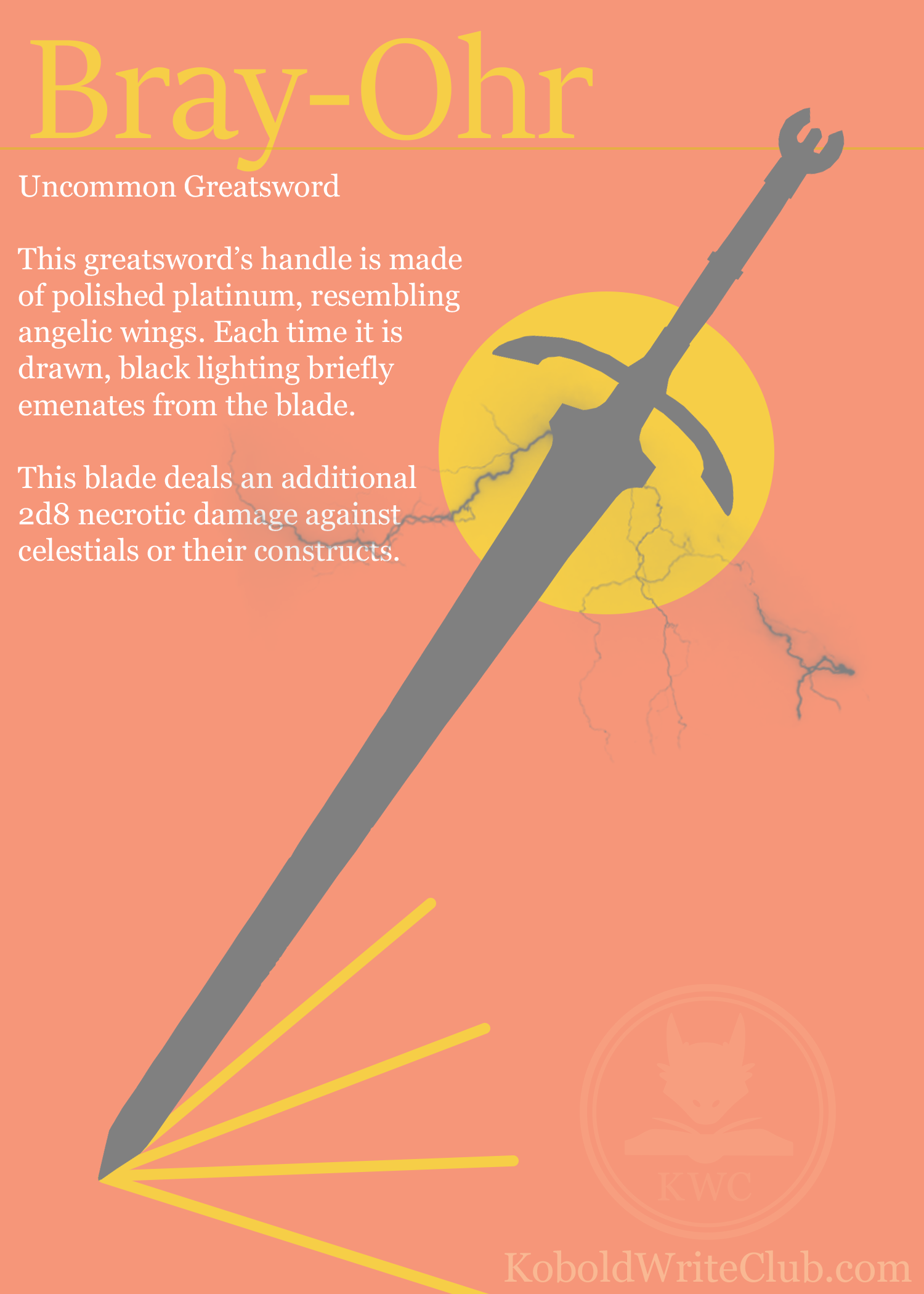
Bray-Ohr - An Anti-Angelic Greatsword

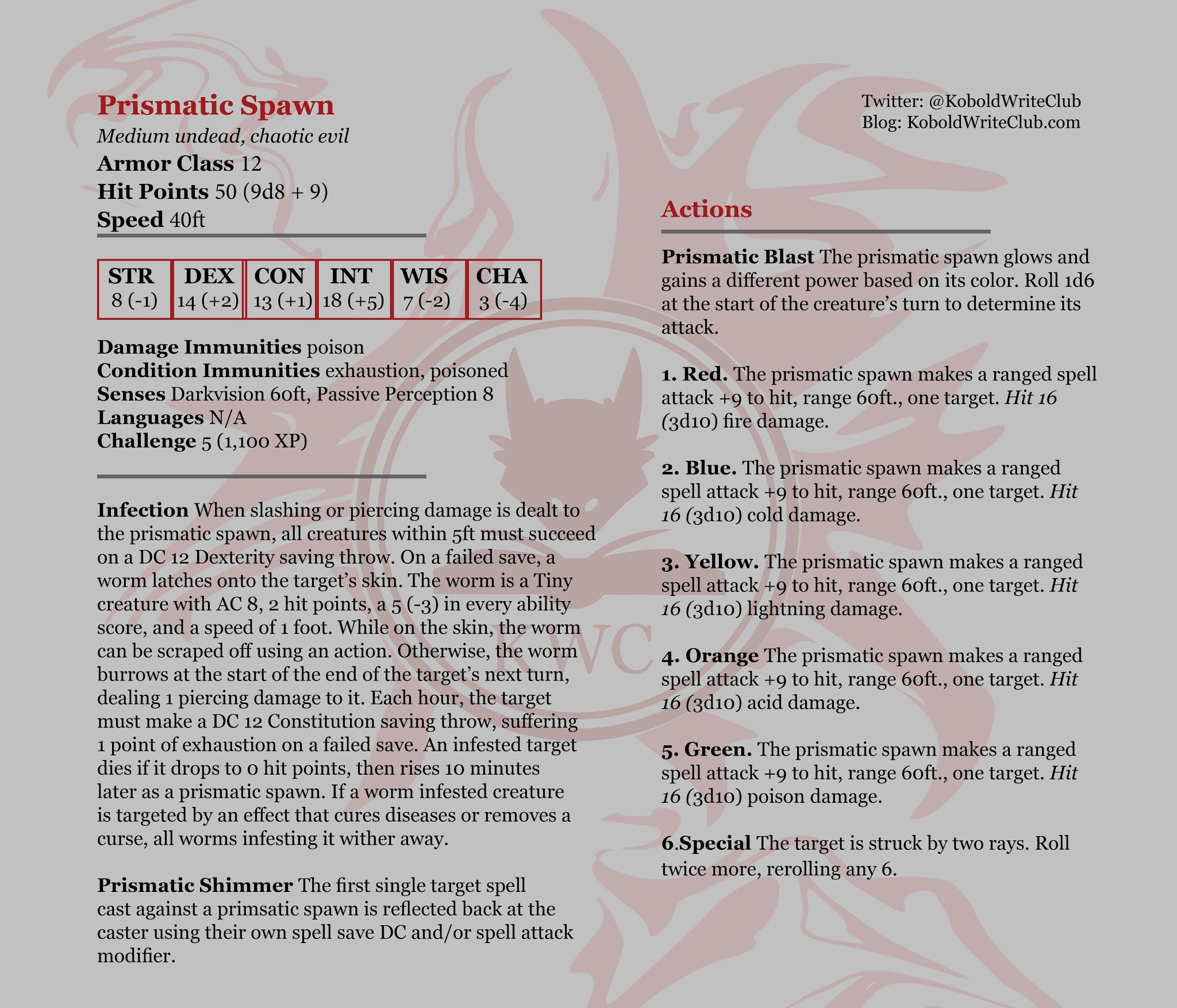
An ancient blade, its purpose long since served. Now, its angel-slaying powers lay dormant, a fragment of what they once were. Perhaps, after all, the power truly was in that of the wielder.


Friday, April 8, 2022

Motivations for the Mistreated: The Vengeful

Many of our adventurers come from heroic origins. They were the light of their town, a great intellect who sought out forbidden knowledge, or a hard-fought mercenary that earned their keep through skill and quick reaction times. But that isn't the case for many adventurers. Many of those you play and sink into the role of will have been brought to this cruel world through hardship, necessity, and pain. 

The backgrounds provided here are meant to aid in roleplay and character creation for Dungeons and Dragons 5th edition. These are the underdogs, the wronged, and those forgotten in the churning wheel of society. In its ever-march forward, those that aren't crushed arise with a purpose, oftentimes unyielding in their ultimate pursuits. 


1. The Vengeful: 

You have been wronged, slighted, betrayed, or some horrid combination of the three. This path can lead to Paladin, but it doesn't need to. For, the Vengeful can accomplish their task through any means necessary. Your path is a difficult one, and the group or individual who wronged you is fixed in your goals. You will exact your vengeance, no matter how long it takes. 

Skill Proficiencies: Intimidation, Investigation
Tool Proficiencies: Disguise Kit
Equipment: Evidence of your perpetrator's wrongdoing, a set of common clothes, and a pouch containing 10 gp. 

Wrongdoings:

Many manners of wrongdoings may have befallen your character. A loved one may have fallen under a bandit's blade. Your business could have been set aflame by a competitor. Or maybe something more ephemeral was at work. The works of a dark mage destroyed your homeland, or a tribe of monsters stole away something precious to you. Feel free to create your own event or roll on the table below for inspiration. 

D8 - Defining Events
  1. A loved one was murdered
  2. Your family's most treasured heirloom was stolen 
  3. A fire destroyed your business, and you know who did it
  4. An encroaching army forced you into subjugation 
  5. Your child was stolen by a dark cult, claiming them a chosen one
  6. An opposing noble household has dragged your name through the dirt
  7. You were wrongly convicted by a corrupt official 
  8. Your life's work was plagiarised and used for great success 
Feature: Recollection 

You ensure that you never forget a face, voice, or a person's appearance. Anyone could be a lead, and you will remember if someone wrongs you again, for you will track them down. You keep a detailed logbook of every notable encounter, person, and conversation you have. If you have met someone, you can immediately recall who they were, what they were wearing, when you met them, and the general details of what was said during your interaction with them. 

Suggested Characteristics

One may be openly vengeful and hostile, or this vengeance could be a deeply-held secret that the character keeps close to their chest. Some will walk over others to accomplish their goal while others may take more subtle approaches to avoid inflicting wrongs on others. The following Personality traits, Ideals, Bonds, and Flaws can be picked, rolled, or ignored to suit your character's story. 

D6 - Personality Traits 
  1. I distance myself from others to avoid being betrayed again.
  2. I am empathetic and often stop what I am doing to hear people out.
  3. I am nervous, always looking over my shoulder in case they show up.
  4. I distrust authority, often going against an authority figure's judgment or rules.
  5. There is no such thing as being too careful or planning too much for a situation.
  6. Once I make a friend, I am unshakingly loyal to them.
D6 - Ideals
  1. Dissent: I will ensure that any structure or institution that upholds or enables subjugation is burnt to the ground. (Chaotic)
  2. Aide: If someone, anyone, is in need then I will be the one to help. (Good)
  3. Cynicism: You are your actions in the present. No promises can be made, and you are not redeemable. (Evil)
  4. Driven: I will accomplish my vengeance, but I will not let others be pained by my path. (Lawful)
  5. Choice: Each and every one of us has chosen a path, and my choice is my own to make. (Neutral)
  6. Unerring: I don't care who or what stands in my way, those who wronged me will be brought to justice. (Chaotic)
D6 - Bonds
  1. My family faced wrongdoings because of my actions, and I will make sure to repay them. 
  2. My spouse is waiting for me back home. I must not disappoint them.
  3. I am going to change the world so that this never happens to anyone else ever again. 
  4. My god/patron says I alone can bring this wrongdoer to justice.
  5. If word got out about what happened to me, my family's reputation would be ruined. 
  6. My child will not be raised in a world plagued by their corruption. 
D6 - Flaws
  1. I think most people are lying to me. 
  2. I value my self-preservation above all else, including those I consider friends. 
  3. Money corrupts. I will never trust those with wealth.
  4. I'm afraid of the dark...bad things happen in the dark. 
  5. I will never forgive you if you wrong me. 
  6. You are guilty until I prove you innocent.